

I’ve baked a lot of cakes that ask for a long ingredient list and a full sink of dishes. This isn’t one of them.
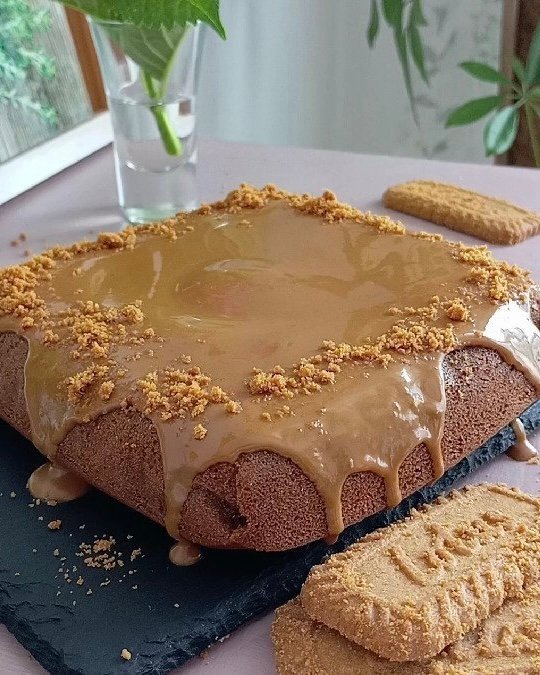
This Lotus Biscoff cake is the kind I make on a normal day—when I want a soft, sweet slice with that caramel-spice Biscoff taste, but I don’t want to pull out the mixer, separate eggs, or measure ten different things. It’s basically a biscuit-based batter that bakes up into a simple, tender cake, then gets finished with a thin layer of melted Biscoff spread on top.
If you’ve got Lotus biscuits, milk, baking powder, and a spoonful of spread, you’re already there.
What this cake tastes and feels like
Because the base is made from ground biscuits, the crumb is different from a classic sponge cake. It’s a bit denser, but still soft, with a slightly “pudding-cake” feel when it’s warm. Once cooled, it slices neatly and holds its shape. The Biscoff spread on top sets into a glossy layer that adds sweetness and a stronger Biscoff hit in every bite.
It’s not fancy, and that’s exactly why I like it.

Ingredients (and what each one does)
250 g Lotus biscuits
These are doing most of the work here. When you grind them up, they become the “flour” of the recipe, plus they already bring sugar, spices, and that caramelized flavor.
Tip: If your biscuits are slightly stale, this is a perfect use for them.
1/2 packet baking powder
This gives the batter lift so the cake isn’t heavy. “Half a packet” depends on where you live—packets vary. In many places a packet is around 10–12 g, so half would be about 5–6 g (roughly 1 to 1 1/2 teaspoons). Don’t stress too much; this recipe is forgiving.
200 ml hot milk
Hot milk helps the ground biscuits soften quickly and turns everything into a smooth batter. It also helps the cake bake up evenly without dry pockets.
2 tablespoons Biscoff spread
This is for the topping. Melted and poured over the cooled cake, it makes a simple glaze that looks good and tastes like the top layer of a Biscoff cheesecake—without the effort.
Optional: crushed biscuits for decoration. I do it when I want the top to look less “plain,” but I skip it just as often.
Equipment you’ll need
- Food processor, blender, or a zip-top bag + rolling pin (to crush biscuits)
- Mixing bowl + spoon/spatula
- 20×20 cm baking pan
- Baking paper
- Oven
- Small bowl + saucepan (for bain-marie/double boiler) or microwave to melt the spread
Step-by-step instructions (exactly how I do it)
1) Prep the pan and oven
- Heat your oven to 180°C (or up to 200°C if your oven runs cool).
- Line a 20×20 cm pan with baking paper.
I like leaving a bit of overhang on two sides so I can lift the cake out easily later.
2) Grind the biscuits
- Weigh 250 g Lotus biscuits.
- Grind them into fine crumbs.
My note: I try to get them fairly fine, like sand. A few tiny bits are totally fine, but big chunks can make the texture uneven.
3) Mix the dry ingredients
- Tip the ground biscuits into a mixing bowl.
- Add 1/2 packet baking powder and stir to combine.

4) Add the hot milk
- Heat 200 ml milk until it’s hot (not necessarily boiling—just properly hot).
- Pour it into the bowl and stir right away.

At first it can look like it won’t come together, but after a minute of stirring it turns into a smooth, thick batter. Make sure you scrape the bottom and sides so there are no dry patches hiding.
5) Bake
- Pour the batter into your lined pan.
- Smooth the top with a spoon or spatula.

- Bake for 30 minutes at 180–200°C.
How I check it:
The top should look set and not wobbly in the middle. If you insert a toothpick, it should come out mostly clean—maybe a few moist crumbs, but not wet batter.
6) Cool the cake
This part matters, because the topping goes on best when the cake isn’t warm.
- Let the cake cool in the pan for 10–15 minutes.
- Then lift it out using the baking paper and let it cool completely on a rack or board.
If you’re in a hurry, you can speed it up by putting it near an open window (that’s my real-life method).
7) Melt the Biscoff spread and pour it on top
- Melt 2 tablespoons Biscoff spread using a bain-marie (double boiler):
Put the spread in a heatproof bowl over a saucepan with gently simmering water. Stir until melted and runny.
Shortcut: microwave it in short bursts (10–15 seconds), stirring each time. It melts fast, so don’t walk away.
- Pour the melted spread over the cooled cake and tilt the cake gently so it spreads.

8) Decorate and slice
- Sprinkle crushed biscuits on top if you want.
- Let the topping set for 10–15 minutes, then slice into squares.
Tips that actually help (from making it more than once)
Use fine crumbs for a smoother cake
If the biscuits are left too chunky, you’ll get random hard bits and the cake can feel uneven. A quick extra grind makes a difference.
Don’t skip lining the pan
This cake likes to cling a bit. Baking paper makes removal easy and keeps the edges neat.
Adjust baking temperature based on your oven
If your oven browns quickly, stick to 180°C. If it tends to underbake the middle, go closer to 190–200°C. The goal is a set center without drying it out.
Let it cool before topping
If the cake is warm, the Biscoff spread soaks in and disappears. Still tasty, but you lose that simple glossy top layer.
Want it thicker or thinner?
- Thicker slices: use a smaller pan (the bake time may need a few extra minutes).
- Thinner slices: use a larger pan (reduce bake time slightly and watch closely near the end).
Storage
- Room temperature in a sealed container: 2–3 days
- Fridge: up to 5 days (it will firm up more)
If chilled, I like letting a slice sit out 10 minutes before eating so it softens again.
Easy variations (optional)
These are not “necessary,” but if you make it often, it’s nice to switch it up:
- Extra topping: melt 3–4 tablespoons spread instead of 2 for a thicker layer.
- Crunchy top: add a handful of crushed biscuits and a pinch of salt (sounds small, helps a lot).
- Serve it with: plain whipped cream, or a spoon of Greek yogurt if you want something less sweet alongside.

Lotus Biscoff Cake
Ingredients
- 250 g Lotus biscuits
- 5 –6 g baking powder
- 200 ml hot milk
- 2 tbsp Lotus Biscoff spread melted
- Extra crushed Lotus biscuits for decoration (optional)
Instructions
- Preheat the oven to 180–200°C and line a 20×20 cm pan with baking paper.
- Grind the Lotus biscuits into fine crumbs.
- Transfer the crumbs to a bowl and mix with the baking powder.
- Pour in the hot milk and stir until the mixture is smooth and evenly combined.
- Pour the batter into the prepared pan and spread it evenly.
- Bake for about 30 minutes, or until the cake is set in the center.
- Let the cake cool completely in the pan.
- Melt the Biscoff spread using a bain-marie or short microwave bursts, then pour it over the cooled cake.
- Decorate with extra crushed Lotus biscuits if desired.
- Slice into squares and serve.
Notes
- Let the cake cool fully before adding the melted Biscoff topping so it stays as a visible layer on top.